It’s the time of year in Chicago when coughs and sniffles are a steady background track to our daily activities. Part of that is unenviable throat clearing. It could be pre-cough, post-cough, or a simple reaction to the dry air. But throat clearing is usually not a sign of strong health, nor is it a sign of strong writing.
Throat clearing in writing refers to words or phrases that are unnecessary to the author’s message. Eliminating these words from your writing can lead to more effective, focused prose. For example: “I’m really pretty happy with the direction this whole project seems to be going in” is a long way of saying “I’m happy with the progress of the project.”
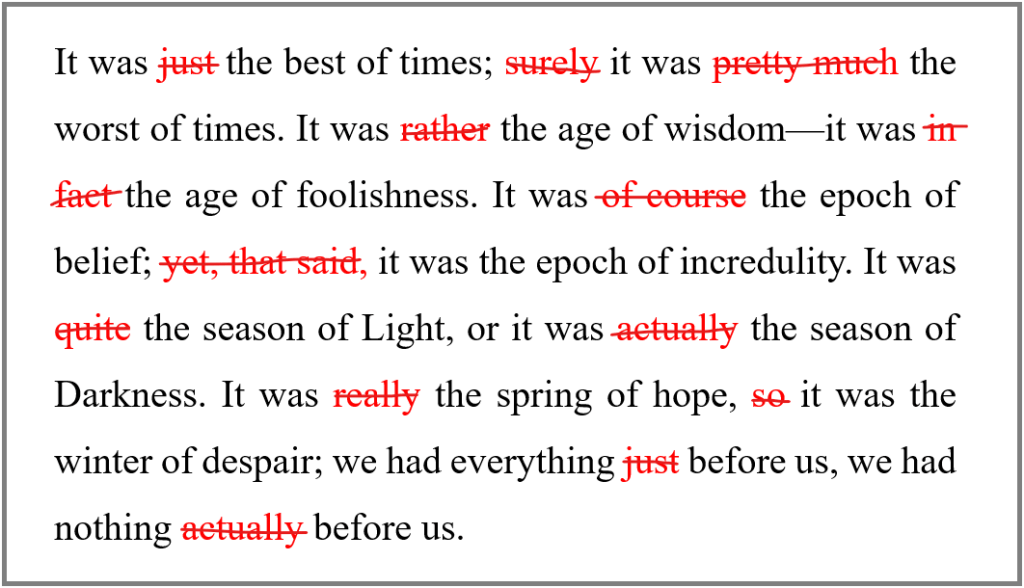
In Dreyer’s English, longtime copy chief of Random House Benjamin Dreyer suggests an exercise for both writers and editors: to spend one week without using “throat clearers” in writing or speech. If you take out these little words and find there isn’t much substance remaining, it may be time to rework the sentence.
The following terms are considered throat clearers and can often be eliminated to strengthen writing:
- very
- rather
- really
- quite
- that said
- actually
- in fact
- just (to mean merely)
- so
- pretty (as an adverb: it’s pretty cold, we were pretty happy with it)
- of course
- surely
That said, I’m actually quite sure that this task would surely be a challenge for many. Or, without the throat clearing: This may be a difficult task. But it can also be helpful in thinking through what you want to say and using more precise words to get there.
Looking to pare down your text with expert help? Consider what option may work for you by reviewing my Services page.
*Read the full text of A Tale of Two Cities for free on Project Gutenberg.
 Natalie Roth Editing Services