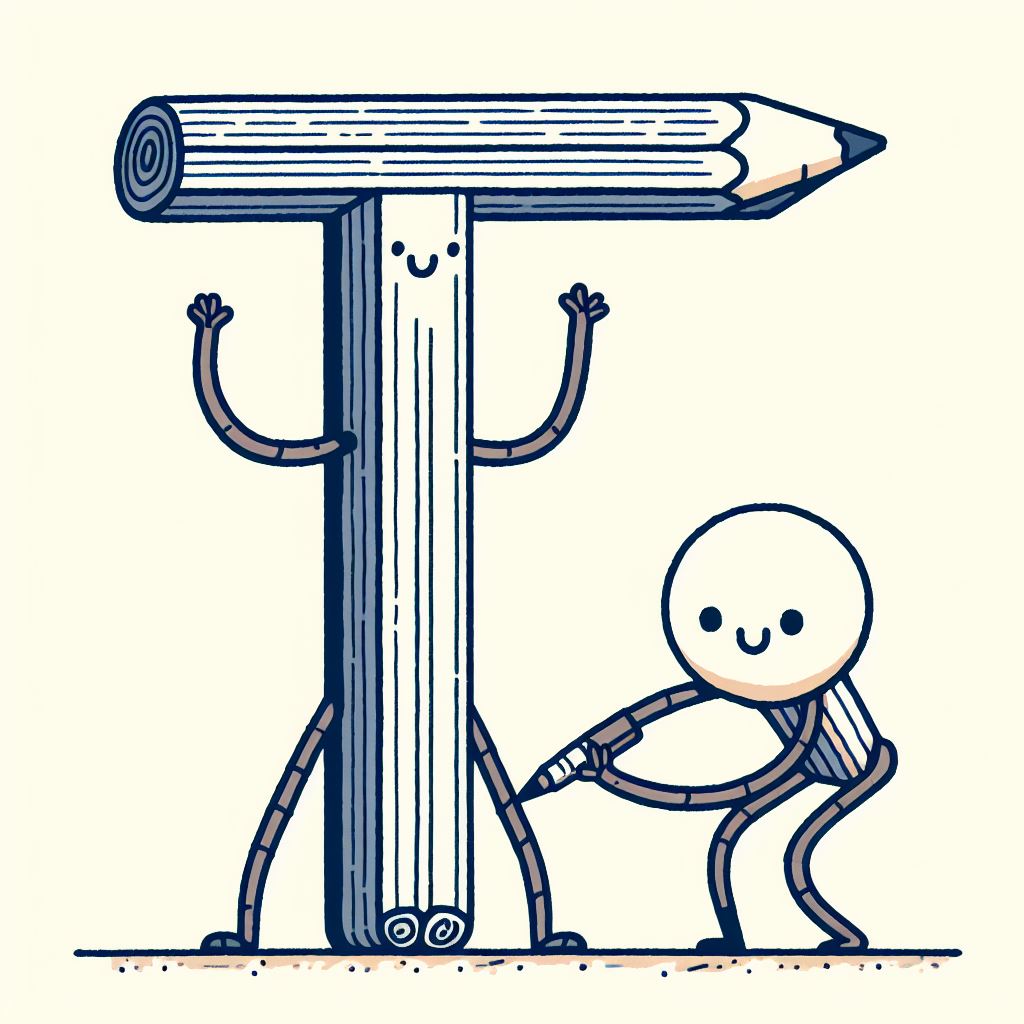
Now that we’re not in T-shirt weather, I’ve been reading about characters who are. They’re wearing tee shirts with phrases on them and designing concert Ts for their own bands. One thing they are not doing is wearing t-shirts, with a lowercase T. Merriam-Webster lists both T-shirt and tee shirt, with good reason: the classic T-shirt is shaped like a capital T. More of a turtleneck collar, perhaps, would justify a lowercase T, but in the meantime a T-shirt is more comfortable capitalized.
T-shirts are more common than t-shirts. Doodle by Natalie Roth
Besides looking up “T-shirt,” I’ve been toggling between Microsoft Word and Merriam-Webster this week to verify how to treat many other words, like makerspace and car seat. It helps to know that lifelike is one word, while life-size has a hyphen. This may be the less glamorous side of copyediting (or copy editing, depending on your style), yet it is so satisfying to know that the project spellings fit the dictionary spellings to a T.
I asked Bing AI for a doodle, and here’s what I got! Created using Bing AI’s DALL-E 3, November 17, 2023
Looking for someone to verify those little details on your latest project? You can ask me about copyediting using my Contact page.
Sometimes as an editor, my role is to trim words. For instance, shortening “they reached the conclusion that” to the more succinct “they concluded…” This week, my focus was pulled toward another type of trimming—not words, but actual clay. I’ve been taking a pottery class this month, and we’ve gotten to the stage called trimming. Much like editing words, trimming clay is the step that comes after the first draft. The mug, bowl, plate, vase, etc. has been formed and set aside to dry. It’s mostly formed; we can see what the artist was going for, even as we can see that it is not quite finished yet.
Once the clay item is ready to be handled with fresh eyes and hands, you can re-center the piece on the wheel, secure it to the base, and get out your trimming tools to give the clay piece a nice finish. This step includes cleaning up scraggly or uneven parts and smoothing over any unwanted smudges with a bit of water.
Trimming tools ready for use. Photo by Natalie Roth
The trimming process has some of the same uncertainty, discernment, and skill of the formation stage. Paying attention to the clay, running your hands over it, gently feeling for consistent thickness, and smoothing out the rough ridges. There’s a peacefulness and sense of accomplishment in seeing that clunky, thick clay around the edges get whittled off, leaving behind a perfectly smooth bowl ready for the kiln.
As I finished trimming my final pieces of formed clay to be something near an actual bowl or mug, ready for the next part of its journey, it clicked that I’d had a similar sense of quiet attention, hope, and pride this week upon finishing a big copyediting project. I’d trimmed the excess words and flagged inconsistencies. I’d smoothed out rough edges in the book and prepared it for the next step in its publishing journey.
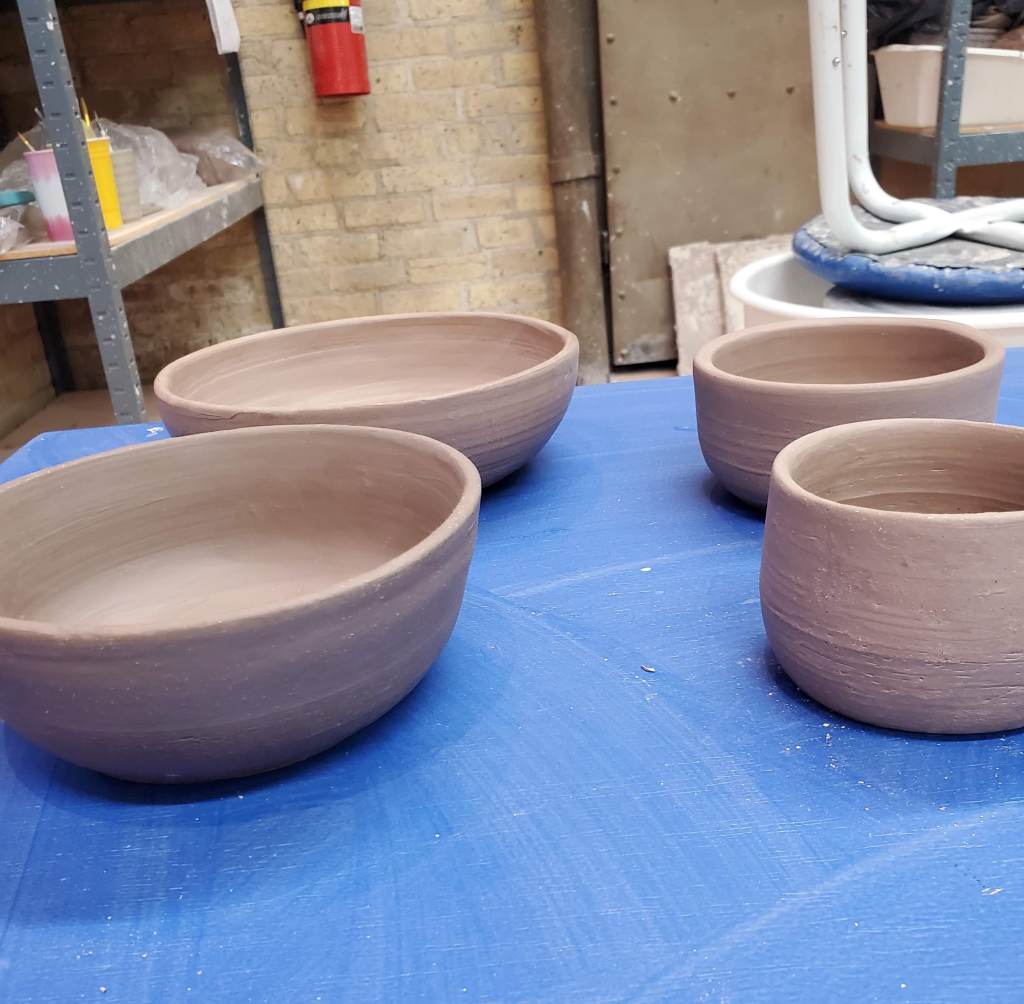
Four of my pieces trimmed and ready to dry more before bisque firing. Photo by Natalie Roth
And for both, I find myself thinking: what comes next? For pottery, I quizzed the instructor on each of the upcoming stages. And for the self-published writing, I referred to Jane Friedman’s checklist: https://janefriedman.com/self-publishing-checklist/. In her checklist, she breaks down each stage in the self-publishing process so writers can plan how to move forward as they work through the editing, design, and proofing stages of a book.
Whether the project is clay-based or word-based, it is helpful to set it aside for a bit and return later with a fresh perspective. If you’re considering a copyedit for that part of the process, you can read more about the different types of “trimming” that I do by visiting my Services page.
This week it has been a joy to walk around and notice the leaves changing colors. Today I stopped to admire the trees lining my street, how orange and yellow leaves on some trees blend with the remaining green to create a mosaic of color in the bright blue sky. The crisp autumn air feels just right paired with those leaves.
Admiring the autumn colors. Photo by Natalie Roth
It may be the lead-up to spooky season, of ghouls and monsters ready to pounce on trick-or-treaters, but it is also a season of apple pie and cozy sweaters, of trading in the sprinting pace of summer for the cozy comforts of fall.
One of my comforts this week is also the punchline to a corny joke (Why are all the numbers scared of 7?). That’s because section 7.89 is my go-to resource from the Chicago style manual when I’m checking whether to hyphenate a compound term. For instance, if a color is described in two words, do those words need to be hyphenated? It may depend on where the term is used in the sentence. I can wear an emerald-green sweater, but I’d say that the sweater is emerald green. “Emerald green” is hyphenated when it comes right before a noun, but it is left as two separate words when it is after a verb. This applies to a lot of compound terms. George Washington is on the one-dollar bill (hyphen), and this bill is worth one dollar (no hyphen).
Something else to consider with hyphen use is what the part of speech is. A compound noun may be two words, but then it needs a connecting hyphen when it is used as an adjective. If a class lasts a half hour, I can describe it as a half-hour class. If I like mountain climbing, I’d be considered a mountain-climbing enthusiast. That hyphen makes it clearer that the noun is being used as an adjective—that the reader should keep reading for the noun.
Those are my two favorite hyphen uses to remember. For everything else, I turn to 7.89 and look up the compound term and whether hyphens are recommended. It’s reassuring to see clearly written on the page that it is correct to say a ten-year-old (hyphenated noun) as well as a ten-year-old child (hyphenated adjective), but to omit the hyphens if I wanted to say a child is ten years old…and yet, all three individuals are likely to be eagerly awaiting their candy haul at the end of the month!
Whether your writing leans into the spooky or cozy sides of the season, consider how the thoughtful attention of an editor can improve the consistency and clarity of your project. Learn more about the stages of editing on my Services page.
Now that we’ve reached October, Halloween decorations have been slowly popping up in my neighborhood. Each time I go for a walk I see new cobwebs, gravestones, pumpkins…and lots of skeletons. Skeletons that are five inches to twelve feet tall, that have two heads, or light up, or are dressed up for the colder weather. Some are just a head and bony hands reaching out from the grass or supported by a tall shrub, reminding me of Hamlet holding a skull in the iconic scene from Shakespeare.
A friendly neighborhood skeleton greets passersby. Photo by Natalie Roth
When I get back from my walk around the block, I sit down to edit the subheadings of a science article and I find myself recalling another moment from Hamlet—that phrase, to be or not to be—as I review which words to capitalize.
It’s those little words that get me. To, it, as, but, for. When you’re writing a title, heading, or subheading, there’s no one right answer for capitalizing these little words. For instance, I’ve titled this post in Chicago style: conjunctions like “or” stay lowercase and so do articles (i.e., a, an, the). The preposition “to,” meanwhile, is capitalized when it’s the first word but not when it’s in the middle of the title. Now if I were to write the title in AP style, which is typically used for newspapers and magazines, the “to” gets capitalized both times, because AP style also capitalizes the word when it is used as an infinitive (the infinitive here being “to be”).
So the answer to which words get capitalized in a heading depends on the context of how the word is being used and the style of the document—a newspaper headline won’t follow the same guidelines as the subheading of a nonfiction trade book, for instance.
When in doubt, or if you’re curious to compare all the style guides, you can check out https://capitalizemytitle.com/. This free tool lets you type in any headline and toggle among Chicago, AP, MLA, APA, and other styles to see what words to capitalize. Like any digital tool, it might not always pick up on things that a human would, such as whether a word is being used as an adverb (the other instance of capitalizing “to”), but it is a great start to proper formatting and a quick way to double-check your thinking as you review the capitalization in titles and headings.
Whether you’re dusting off the cobwebs of an old piece of writing or drafting fresh content from a bare-bones outline, consistent capitalization is a small way to add a little extra boost.Do you have a piece of writing ready for those decorative touches? Tell me about it using my Contact page.
I sang along to this and other Motown songs when I was younger, and I still get caught up in the catchy tune. But this week, when an article I edited used the word “postman,” I paused on the word. Language has changed since the Marvelettes first sang the tune in 1961. Some might say the term is old-fashioned, that it should be “mailman.” Others might point out that postal workers aren’t just men anymore, and the term should be a gender-neutral term such as “letter carrier.” The latter is in line with the latest APA Style Guidelines for bias-free language, which advocates for choosing language that is inclusive and respectful. You can see their entry on avoiding gendered occupational titles here.
As an editor, I have the opportunity to spot problematic language and check in with the writer about their intent. Does a certain word choice unnecessarily exclude people or introduce bias? Does the phrasing come across as disrespectful; was that the intent? I try to thoughtfully consider the language that I find on the page, and it’s an ongoing process.
This past week I added to my awareness by attending an ACES editing webinar on potentially problematic language. Some of the examples were good reminders of things I’d heard before about considering wording used around race, gender, and mental health. For instance, saying someone “suffers from depression” is biased compared to simply stating that they “have depression.” Another piece of advice was to consider the language that advocacy groups recommend and to think through the pros and cons for choosing terms when there’s no consensus. Ask: Is this word choice perpetuating a harmful stereotype? Is it respectful to readers? The editing stage is the perfect time to catch and consider these moments so that the writing fits the intent.
Whether it’s a handwritten letter from a loved one or the latest novel from your favorite author, words connect us to ideas and feelings. Yet language is changing all the time, so it’s a good idea to think about what ideas and feelings underlie particular word choices. Conscious language guides from advocacy groups and editing associations are great tools to keep up with language trends. Some of these guides are helpfully compiled by editor and authenticity reader Crystal Shelley here.
Looking for an editor to bounce ideas off of and thoughtfully provide feedback on the language in your writing? Send me a message on my Contact page.
I worked from a café recently, and as I sat there editing and sipping my drink, my attention drifted in and out of what song was being piped through the speakers. I paused for a moment when the theme song of Xanadu started playing. My mind flashed to the memory of a few months back, when I’d gone to see a rerun of the film with a friend. Several people had shown up to the theater in full costume, complete with roller skates. We’d gone for a slice of pizza after the show, chatting about the film and about life before I had to catch the last bus home.
Having a musical Proustian moment. Photo by Natalie Roth
The next song to grab my attention was “I Love the Nightlife (Disco Round)” by Alicia Bridges. They used to play this song on a TV infomercial when I was in high school. The producers had paired song clips from the 1970s with cheesy commentary to lure nostalgic viewers to buy a box of CDs. With nothing else on—life without cable and this was pre-streaming—it was the default background noise for those lazy nights when it wasn’t quite time for bed. It was on often enough that my sister and I knew all the songs before long. I never bought the box set, but many of those songs transport me back to those nights hanging out with my sister.
It may have been the caffeine kicking in, but the familiarity of these songs stirred me up. I glanced around at the other people in the room and thought, We all know these songs; they are songs that have played on the radio longer than I’ve been alive. They connect us, yet they also just fade into the background. Maybe this song played at that woman’s first dance. Maybe it was blaring from the speakers at the start of the marathon that guy ran. Maybe it plays overhead every twentieth time that person goes to the grocery store. Innocuous, happy, bittersweet…any number of emotions or memories could be attached to different songs for different people. We’re all brimming with stories, and music can be the soundtrack to those stories.
As Chaka Khan’s “I’m Every Woman” started playing, I noticed the spaced-out stare of another diner sharing the same song but thinking her own thoughts and recalling her own memories. It felt fitting to sit there, wondering what she might be thinking, and to hear Chaka sing, “I can read your thoughts right now / Every one from A to Z.”
Music is a big part of my life, with certain moments and memories frozen in different songs. What songs are in your life’s soundtrack? Check out this list of novels that feature music. Or write your own! Learn more about how I can helpby visiting my Services page.
I’ve spent the past two weeks immersed in the world of Dungeons & Dragons for the very first time. It’s a world I knew was there, knew friends or friends of friends who liked it, but had never entered it myself. And was I in for some surprises.
When I was approached to copyedit a cocktail book that was inspired by and engaged with the world of D&D, I didn’t realize that it would ask for the same engagement from me. And yet, the language is just a step away from standard English, requiring a careful review of phrases that might at first appear to be errors. The creatures include goblins and fairies, but they aren’t like those found in traditional fairy tales.
When I think “enchantment,” I return to the stunning views in Killarney, Ireland. Photo by Natalie Roth
This project required a lot of research and fact-checking to make sure that I understood what the typical target reader understood. It had me very grateful for the timely help of more knowledgeable people online and in real life as I built a clearer picture of how things worked in this creative world. And even though I’ve turned over my edits, I haven’t turned over the sense of awe this project gave me for the incredible world-building and imagination that comes part and parcel with D&D.
More details to come on the book as it reaches publication! In the meantime, what worlds live in your head? You can tell me about the creative projects you are building by using my Contact page.
Since my last post on editing out the fluff, I happened upon the book Stylized by Mark Garvey, which dives into the history behind Strunk & White’s The Elements of Style. Garvey follows the publication journey of the book as E. B. White worked to update Strunk’s original rules, with side journeys into the style guide’s meaning and impact. This iconic style guide aligns with the idea of removing fluff, with one rule simply stating “omit needless words.” Yet, as Garvey explains, this isn’t an all-encompassing or straightforward right-and-wrong guide to writing. Strunk had simply noticed what good writers were doing and used his style guide to point out the rules beneath their words.
E. B. White was one of the students influenced by this approach to writing, and his appreciation for Strunk’s teaching led to his involvement in getting the style guide more widely published as we know it today. White spent many years writing at The New Yorker, and playwright Marc Connelly reportedly described his contribution as bringing “the steel and the music to the magazine.” Consistently applying rules of language gave him a strong base on top of which his writing could sing.
Steel and music come to life in the curved stainless steel of the Walt Disney Concert Hall, an iconic building designed by architect Frank Gehry to bring music to the city of Los Angeles. Photo by Natalie Roth
An analogy Garvey uses to explain this idea of steel and music, or rules and play, is to think of the way a bird relies on rules in nature. It needs gravity, friction, wind, and air pressure to get where it’s going. In the same way, a good writer learns the rules of language so that they can then navigate and play with them to get where they want to go.
As an editor, I work with an author to help them get where they want to go with their writing. Often that means applying grammar and style rules in a way that improves clarity and flow. When I took a class in grammar for editing, the somewhat dry material certainly didn’t feel like play—because it was the steel. I can now use this steel to reinforce and empower the creativity of the author, and it is then that we get the music.
Do you have a piece of writing you want to sing? Tell me about it using my Contact page.
With summer in full swing, I had the opportunity to go to a pro baseball game recently. The weather turned out perfectly, and I found myself soaking up the sunshine while watching “America’s pastime.” I didn’t grow up regularly watching sports, but I’d heard the hubbub this season about the changing MLB rules and I was curious enough to check it out.
Baseball and editing: every dot, or player, in place. Photo by Natalie Roth
The new rule changes shave about a half hour off the game time. A few seconds here, a few seconds there. The game was now a little more streamlined, making it a bit more welcoming to new spectators…just like an edited piece of writing!
Taking out the fluff is a standard step when I edit articles for business websites. These are phrases or sentences that don’t add anything new to the piece and can be cut without anyone missing them. The end result is a punchier, more focused piece of writing that is easier on the reader’s attention span.
I enjoyed taking in the atmosphere at the ball park and I didn’t miss any of the cut “fluff” time. Whether it is baseball or business articles, taking a thoughtful, organized edit to the project can produce a more enjoyable experience for a wider audience.
Even if you’re not a sports fan, baseball has seeped into the language of everyday conversation. Check out this list of 10 Common English Baseball Idioms and see how many you use already! And if you’re looking for editorial services, learn more about how I can help by visiting my Services page.
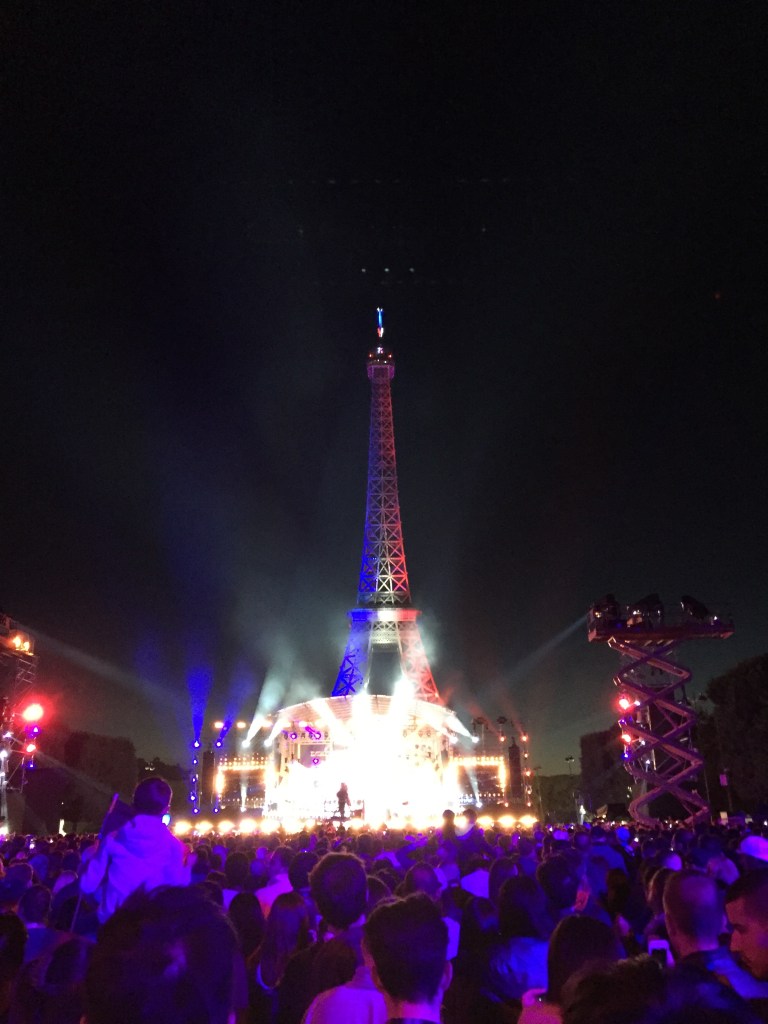
A few days ago was Bastille Day, what my brain’s shorthand considers the French equivalent of our July 4th. Each year now, the date takes me back to the year I celebrated Bastille Day in Paris with a picnic and fireworks. These fireworks were memorable because I got to watch them from the lawn in front of the Eiffel Tower.
Eiffel Tower lit up for Bastille Day concert and fireworks display in 2016. Photo by Natalie Roth
As the fireworks brightened the sky and then faded out over this iconic monument, another light display gradually took its spot next to the Eiffel Tower as well: the Big Dipper. It’s one of the easiest constellations to spot and here it was, ready to be spotted. Yet some people don’t know it as the Big Dipper. If they grew up in the UK, they may call it the Plough. Others link this set of stars to Ursa Major, the Great Bear, or maybe they prefer the name Drinking Gourd.
My role as an editor is to track which term an author uses and check for consistency. The term they choose can be significant. I worked on a history book project that highlighted how the “Drinking Gourd” pointed to the North Star and thus helped enslaved people navigate their journeys northward and out of enslavement. The National Park Service’s website was one of my go-tos for checking U.S. history facts from writers I worked with. Meanwhile, using the term Ursa Major, the Great Bear, would link the collection of stars to many different oral storytelling traditions and mythologies across the globe.
This constellation contains and inspires a breadth of stories for people to hear or read about and learn something new. Whenever I spot the Big Dipper in the sky, I remember the stories it has been linked to over the years, including my story of seeing it grace the sky next to the Eiffel Tower.
Looking for a thoughtful eye to look over the story you want to tell? Check out the editorial services on my Services page.






 Natalie Roth Editing Services