Improve Your Writing with “Less is More”

It’s the time of year in Chicago when coughs and sniffles are a steady background track to our daily activities. Part of that is unenviable throat clearing. It could be pre-cough, post-cough, or a simple reaction to the dry air. But throat clearing is usually not a sign of strong health, nor is it a sign of strong writing. 

Throat clearing in writing refers to words or phrases that are unnecessary to the author’s message. Eliminating these words from your writing can lead to more effective, focused prose. For example: “I’m really pretty happy with the direction this whole project seems to be going in” is a long way of saying “I’m happy with the progress of the project.”
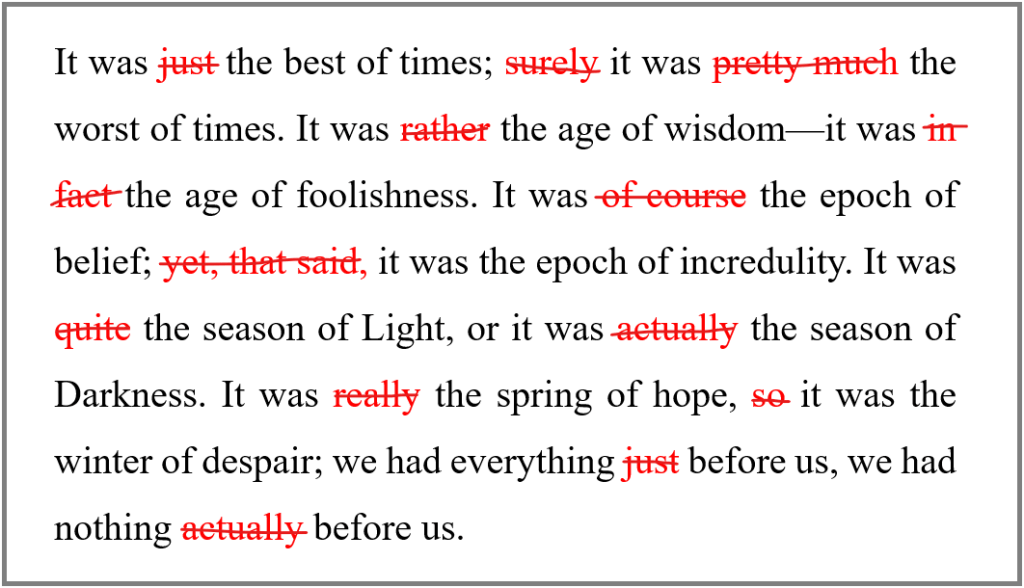
Imagine if Charles Dickens had been throat clearing at the start of A Tale of Two Cities. Would it be as memorable today?

In Dreyer’s English, longtime copy chief of Random House Benjamin Dreyer suggests an exercise for both writers and editors: to spend one week without using “throat clearers” in writing or speech. If you take out these little words and find there isn’t much substance remaining, it may be time to rework the sentence.

The following terms are considered throat clearers and can often be eliminated to strengthen writing:

  • very
  • rather
  • really
  • quite
  • that said
  • actually
  • in fact
  • just (to mean merely)
  • so
  • pretty (as an adverb: it’s pretty cold, we were pretty happy with it)
  • of course
  • surely

That said, I’m actually quite sure that this task would surely be a challenge for many. Or, without the throat clearing: This may be a difficult task. But it can also be helpful in thinking through what you want to say and using more precise words to get there.

Looking to pare down your text with expert help? Consider what option may work for you by reviewing my Services page.

*Read the full text of A Tale of Two Cities for free on Project Gutenberg.

Steel and Music

Since my last post on editing out the fluff, I happened upon the book Stylized by Mark Garvey, which dives into the history behind Strunk & White’s The Elements of Style. Garvey follows the publication journey of the book as E. B. White worked to update Strunk’s original rules, with side journeys into the style guide’s meaning and impact. This iconic style guide aligns with the idea of removing fluff, with one rule simply stating “omit needless words.” Yet, as Garvey explains, this isn’t an all-encompassing or straightforward right-and-wrong guide to writing. Strunk had simply noticed what good writers were doing and used his style guide to point out the rules beneath their words.

E. B. White was one of the students influenced by this approach to writing, and his appreciation for Strunk’s teaching led to his involvement in getting the style guide more widely published as we know it today. White spent many years writing at The New Yorker, and playwright Marc Connelly reportedly described his contribution as bringing “the steel and the music to the magazine.” Consistently applying rules of language gave him a strong base on top of which his writing could sing.

A picture of the Walt Disney Concert Hall in Los Angeles. It is known for its acoustic design within and its multiple panels of stainless steel on the outside, shaped like sails.
Steel and music come to life in the curved stainless steel of the Walt Disney Concert Hall, an iconic building designed by architect Frank Gehry to bring music to the city of Los Angeles. Photo by Natalie Roth

An analogy Garvey uses to explain this idea of steel and music, or rules and play, is to think of the way a bird relies on rules in nature. It needs gravity, friction, wind, and air pressure to get where it’s going. In the same way, a good writer learns the rules of language so that they can then navigate and play with them to get where they want to go.

As an editor, I work with an author to help them get where they want to go with their writing. Often that means applying grammar and style rules in a way that improves clarity and flow. When I took a class in grammar for editing, the somewhat dry material certainly didn’t feel like play—because it was the steel. I can now use this steel to reinforce and empower the creativity of the author, and it is then that we get the music.

Do you have a piece of writing you want to sing? Tell me about it using my Contact page.