Don’t Mind the Mess, or Do

Calm blue water, tall grasses, and pretty bird calls surround me on a somewhat muddy trail I have nearly all to myself. It’s late afternoon and I’m exploring the path of an unassuming wetlands preserve nestled within the city. I see several red-winged blackbirds jumping around the tall grasses, and a great blue heron soaring above the water. The experience feels like a slow, warm breeze in a month full of gusty, loud wind. That I’d found such a spot without a long trek into the countryside makes it feel even more like a secret adventure, even if photos of my little oasis give away that I am merely a ten minutes’ walk from a traffic light.

Wetlands Walk, April 2024, photo by Natalie Roth

After a few more contemplative breaths and careful steps, I find my way back to the entrance of the park. Just in time—a group of preteens with toy water guns are about to enter the trail for their own adventure. I can guess which of the two sections of trail they will have to be careful in navigating, and which they will quickly run through (pictured below).

I’m used to navigating misplaced words, not misplaced paths! Two sections of the same trail, perhaps at different stages of completion. Photos by Natalie Roth

Walking the contrasting segments of trail in the wetlands preserve reminded me of the two types of editing I do, copyediting and proofreading. The first path is messier, trickier; I have to slow down and pay closer attention to where I put my feet or I’ll get muddy. A manuscript with the essence of the top photo may be similarly “muddy” and less stable. It needs to be navigated slowly and thus by a copyedit. Copyediting is an earlier stage of the editing process with texts that need more care and attention. This is where typos, grammar issues, and flow get addressed so that the edited result is one that a reader can more easily understand and navigate. I wouldn’t run through this path or text as is, and neither would a reader.

Proofreading, meanwhile, is taking on a text more similar to the path in the bottom photo. This path isn’t muddy or haphazard, and I can even run alongside if I want. This is like a text that is already orderly and relatively easy to navigate. A reader can breeze through with only a few snags or bumps. Proofreading is the stage that checks for missing words, minor typos that missed the first round, and perhaps an extra comma to give it that finishing touch.

Both paths are part of the editing adventure that leads to that calm blue oasis—which stage are you ready to navigate?

Is your writing project looking more like the top photo or the bottom? Read more about the phases of editing on my Services page.


Natural and Unnatural Wonders

Every year people flock downtown with the same wonder and awe to see the river dyed green for St. Patrick’s Day here in Chicago. One day the river is a murky, dull flow, and the next it is a vibrant, eye-catching wonder. All thanks to a mysterious powder that they’ve tinkered with and specially formulated to transform the river into the city’s last winter decoration before the (hopefully soon!) show of spring.

Bright blue sky and skyscrapers in the background as a crowd gathers along a bridge to look down at the neon green water of the Chicago River
Throngs of excited people line up along the bridge to take photos of/with the festively colored river. Photo by Natalie Roth

While the metaphor won’t hold water if I take it too far, editing is a bit like that behind-the-scenes magic powder, transforming writing from dull to vibrant. Both processes require background knowledge and training to be able to study what’s there and to shape it into what it could be; there’s the same end goal of enhancing the piece and making it jump out to viewers. The origin of the dyeing ritual, according to NPR, was part of the city’s efforts to clean up the water by diagnosing the source of problems. Similarly, an editor helps the writer to spot any glaring or recurring issues in a text, allowing the piece of writing to emerge cleaner and ready for readers to enjoy.

The green dye is a temporary, unnatural-looking alteration to the river’s familiar color, and it will slowly fade as the month goes on. Meanwhile, an attentive edit enhances the natural beauty of what is already there and will still hold up in April, May, and beyond.

What kinds of editing can clean up your writing? Take a look at my Services page.

Each Other versus One Another

“Love each other dearly always. There is scarcely anything else in the world but that: to love one another.”
― Victor Hugo (Les Misérables, Part V, 1887)

What comes to mind when you hear this quote? Is it perhaps an echo of Valentine’s Day? Or a reminder of the need for kindness?

As an editor, the other thing that jumps out to me is the interchangeable use of “each other” and “one another.” This use matches how many people write and talk, but not everyone would agree. Some grammarians recommend using “each other” if referring to two people, and then using “one another” for three or more people. So, a one-on-one chat lets you catch up “with each other” but a group meeting (3+ people) may be to compare notes “with one another.”

Applying this logic to the Hugo quote would shape the meaning of the entreaty to love each other to apply to a couple, while the maxim to love one another would have a more universal quality.

a close-up of smoothed over beach rocks
Two, three, four… I lost count! Beach pebbles stacked on one another. Photo by Natalie Roth

And yet, as confirmed in Merriam-Webster, in actual usage this distinction is often not observed and hasn’t been since the 16th century. The terms can very easily be interchanged. Many people prefer to always use “each other” as it can sound less stuffy, while others switch between the two terms with ease.

In my different editing capacities, I’ve come across style guides that make the distinction, and others that do not. Again, both terms are correct if your style guide allows. Even the dictionary approves of a choose-your-own-adventure approach to these terms. There is one choice I would always flag, however, and that is one I came across in a published book this week: “each another.”

Do you prefer “each other” or “one another”? Would you interchange them, or perhaps even blend them into the term “each another”? Let me know by sending me a note on my Contact page.

Rethink These Phrases in Fiction Writing

“I think to myself, therefore I am.” —René Descartes, not the actual quote.

An animated pencil is looking out the window and has a thought bubble with a question mark inside.

This week I’ve been reading Dreyer’s English, which is densely filled with editing tips on grammar, clarity, and style. From among the many tips in his section for fiction writers (and copy editors), I was taken by his caution against overexplaining everyday gestures. For example, I nod my head—not other body parts. So why not simplify and say: I nodded. I shrug my shoulders—and there aren’t any other body parts you think of if you hear that I shrugged. And finally, I think to myself—I can’t think to anyone else. Dreyer suggests cutting it down to “I think.” These simple edits in a text would look like this:

·        He nodded his head in agreement. > He nodded.

·        She shrugged her shoulders. > She shrugged.

·        I think to myself, Where did the time go? > I think, Where did the time go?

·        I think to myself, What a wonderful world. > I think, What a wonderful world. (Okay, here you may see the difference between lyrics and prose writing. This worked better the first way when Louis Armstrong sang it.)

These tips may not be a fit for every writer and every style of writing, but they are nonetheless approachable, simple tweaks that unclutter a piece of writing. A copy editor’s role is to notice these types of redundant phrases that the writer may have missed and, by doing so, give them the opportunity to think more consciously about their writing.

And what about those times when your character can think at someone else, rather than to themselves? I copyedited a YA novel about mind reading and high school, and the characters did just that. Read the full plot of Mysterious Ways here. This book is also featured on my Projects page.

Pencil image created using Bing AI’s DALL-E 3, January 17, 2024.

Reign, Rain, Go Away: Spotting Common Homophones

A monarch reigns over their country. A budgeter reins in their spending. A gloomy cloud rains down on a city. These verbs sound the same, but they each look and mean something different.

A forest of tall, thin trees towers above moss-covered logs in the foreground at the bend in a dirt hiking path
Moss reigns where it rains more, as seen on a rainy Washington hike in 2023. Photo by Natalie Roth

This past week while editing I spotted this classic typo-not-typo known as a homophone. Homophones are words that sound the same (homo = same; phonos = sound) but have different meanings or spellings.

Common instances of homophones are:

  • their/they’re/there
  • to/too/two
  • your/you’re

It’s easy to type the wrong one by mistake, but usually a pretty simple fix when proofreading a piece of writing with fresh eyes. Then there are some homophones that are a bit trickier, such as:

  • affect/effect
  • capital/capitol
  • complement/compliment
  • rain/reign/rein

These homophones appear less frequently. You may have to pause and think a bit longer about the part of speech and how the word is being used. My role as an editor is full of pauses for things like homophones. Is that word spelled right? Is it used correctly? Let me check. Is that date right? Is it formatted correctly? Let me check. It takes some time, but the end result is a piece that both sounds and looks how the writer intended. And that sounds good to me!

Want to learn more about homophones? Check out Scholastic’s list of Top 20 Commonly Confused Homophones (on scholastic.com).

Do homophones pop up in your writing? Proofreading is often that last stop to read for proper use of homophones and similar issues. Learn more about proofreading on my Services page.

Careful What You Wish For

foreground shows a hand holding a lit candle with a brick fireplace in background
Make a wish and blow out the candle, they say… Photo by Natalie Roth

I’m new to the fanciful world of American author Bill Brittain, but I recently read his books All the Money in the World and The Wish Giver. In both books, the main characters are presented with the opportunity to make a wish for anything they want. But, as is often the case with these magic wish deals, the characters learn the hard way that they have not selected the best wording for their wishes and things start to go wrong, fast.

I’m about to give away a few plot points for the first book; granted, it was written in 1979, but I still wanted to give fair warning.

In All the Money in the World, the main character gets just that—all the money in the world. That includes money from people’s pockets and wallets and under their couch cushions. From all the bank vaults across the globe. And chaos ensues. Yet the phrasing of this wish doesn’t end up getting him what he truly wanted, which was enough money for his family farm to thrive, and for him to buy the same toys as his friends. I couldn’t help but think that, had he phrased his wish with more precision and forethought, to be exactly what he truly meant, it might have gotten him what he wanted without disrupting the whole world.

A similar fate befalls the three children who make wishes in The Wish Giver. Bill Brittain gives them rather careless phrasing for their wishes to get the story rolling. It is a reminder to readers that making a wish for one problem to go away may just bring on a whole new set of problems, and that trying to make all your problems magically disappear is bound to come with a few catches.

Even knowing this lesson, I couldn’t help but play around with how some of the kids could have phrased their wishes. If they’d tweaked their message for clarity and avoided the obvious loopholes or double meanings, would they have gotten what they actually wanted? Having a second opinion to read over the wish before it went out into the world might have at least made it harder for the wish giver to bend their words. I know he would have found some other mischievous way to bring about a silly result, but it doesn’t stop my wishful thinking.

Similarly, having an editor look over your writing may not guarantee all your wishes coming true, but it will help get your message across more clearly and succinctly. It can bring your own writing closer to how you envisioned it. And there’s no tricky magic involved, just know-how and experience.

Have a project that may need an editor? Check out my Services page to see what stages I can help with.

Improve Your Writing with “Less is More”

It’s the time of year in Chicago when coughs and sniffles are a steady background track to our daily activities. Part of that is unenviable throat clearing. It could be pre-cough, post-cough, or a simple reaction to the dry air. But throat clearing is usually not a sign of strong health, nor is it a sign of strong writing. 

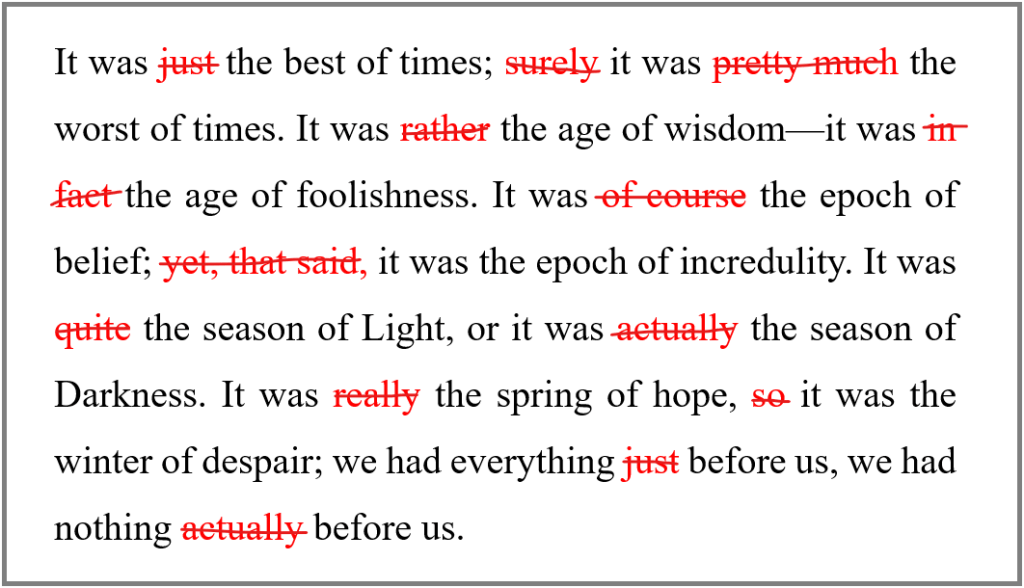
Throat clearing in writing refers to words or phrases that are unnecessary to the author’s message. Eliminating these words from your writing can lead to more effective, focused prose. For example: “I’m really pretty happy with the direction this whole project seems to be going in” is a long way of saying “I’m happy with the progress of the project.”

Imagine if Charles Dickens had been throat clearing at the start of A Tale of Two Cities. Would it be as memorable today?

In Dreyer’s English, longtime copy chief of Random House Benjamin Dreyer suggests an exercise for both writers and editors: to spend one week without using “throat clearers” in writing or speech. If you take out these little words and find there isn’t much substance remaining, it may be time to rework the sentence.

The following terms are considered throat clearers and can often be eliminated to strengthen writing:

  • very
  • rather
  • really
  • quite
  • that said
  • actually
  • in fact
  • just (to mean merely)
  • so
  • pretty (as an adverb: it’s pretty cold, we were pretty happy with it)
  • of course
  • surely

That said, I’m actually quite sure that this task would surely be a challenge for many. Or, without the throat clearing: This may be a difficult task. But it can also be helpful in thinking through what you want to say and using more precise words to get there.

Looking to pare down your text with expert help? Consider what option may work for you by reviewing my Services page.

*Read the full text of A Tale of Two Cities for free on Project Gutenberg.

A Simple Little System

Having an idea is a great start, but can it withstand some scrutiny? Fact-checking is an important step in supporting the legitimacy of a project.

This week I rewatched the film Bells Are Ringing, a 1960 musical comedy with Judy Holliday and Dean Martin. Alongside some playful songs, the writers slipped in a message about the importance of fact-checking. You see, switchboard operator Judy Holliday is unwittingly relaying phone orders for a betting syndicate. The ringleader created a “simple little system” that disguises horse tracks as classical music composers and horses as symphonies. So instead of betting $500 on the third horse to win a race at Belmont Park, the bettor calls up Judy to place an order for 500 albums of Beethoven’s third symphony, and she passes along that information to the supposed music warehouse. (The full explanation can be found in this musical number.)

Viola laying on top of a page of Beethoven sheet music
Beethoven (not Belmont Park) symphony sheet music, ready to be played. Photo by Natalie Roth

But the system can’t weather the scrutiny of anyone with some basic knowledge of classical music. The ringleader gets very flustered when a young grocer’s assistant with an interest in the record company poses a few questions. And the whole operation falls apart because of this young man’s musical knowledge. He happens to be delivering groceries when Judy takes an order for Beethoven’s tenth symphony. He comments that it must be a mistake, that Beethoven only has nine symphonies. (Read more about the “Curse of the Ninth” here.) And so, Judy changes all the orders that day from Beethoven’s tenth to Beethoven’s ninth to match the factsand the ringleader’s simple little system falls completely apart.

This sequence of events is a great lesson in how ideas need to be able to pass scrutiny with the audience. The system was based on lies and a little fact-check poked a big hole in the whole scheme.

I did plenty of fact-checking this week for a fiction manuscript that happened to have multiple music references. All the songs did indeed exist and, once they checked out, they made it onto the style sheet. This is the “simple little system” editors use to track any proper nouns, style decisions, plot points, and characters in one document to ensure consistency. It’s how I caught that a character was given two different last names; it also helped catch a spot where the timeline wasn’t adding up. By the end, my style sheet included a whole soundtrack of songs to accompany the book, and I could report back that the factual details would hold up to reader scrutiny.

Looking for fact-checking and careful attention to the ideas in your story? An editor can help with that! Review the basic categories of editing on my Services page.
Trimming off the Excess

Sometimes as an editor, my role is to trim words. For instance, shortening “they reached the conclusion that” to the more succinct “they concluded…” This week, my focus was pulled toward another type of trimming—not words, but actual clay. I’ve been taking a pottery class this month, and we’ve gotten to the stage called trimming. Much like editing words, trimming clay is the step that comes after the first draft. The mug, bowl, plate, vase, etc. has been formed and set aside to dry. It’s mostly formed; we can see what the artist was going for, even as we can see that it is not quite finished yet.

Once the clay item is ready to be handled with fresh eyes and hands, you can re-center the piece on the wheel, secure it to the base, and get out your trimming tools to give the clay piece a nice finish. This step includes cleaning up scraggly or uneven parts and smoothing over any unwanted smudges with a bit of water.

Multiple ceramic mugs filled with different trimming tools for clay
Trimming tools ready for use. Photo by Natalie Roth

The trimming process has some of the same uncertainty, discernment, and skill of the formation stage. Paying attention to the clay, running your hands over it, gently feeling for consistent thickness, and smoothing out the rough ridges. There’s a peacefulness and sense of accomplishment in seeing that clunky, thick clay around the edges get whittled off, leaving behind a perfectly smooth bowl ready for the kiln.

As I finished trimming my final pieces of formed clay to be something near an actual bowl or mug, ready for the next part of its journey, it clicked that I’d had a similar sense of quiet attention, hope, and pride this week upon finishing a big copyediting project. I’d trimmed the excess words and flagged inconsistencies. I’d smoothed out rough edges in the book and prepared it for the next step in its publishing journey.

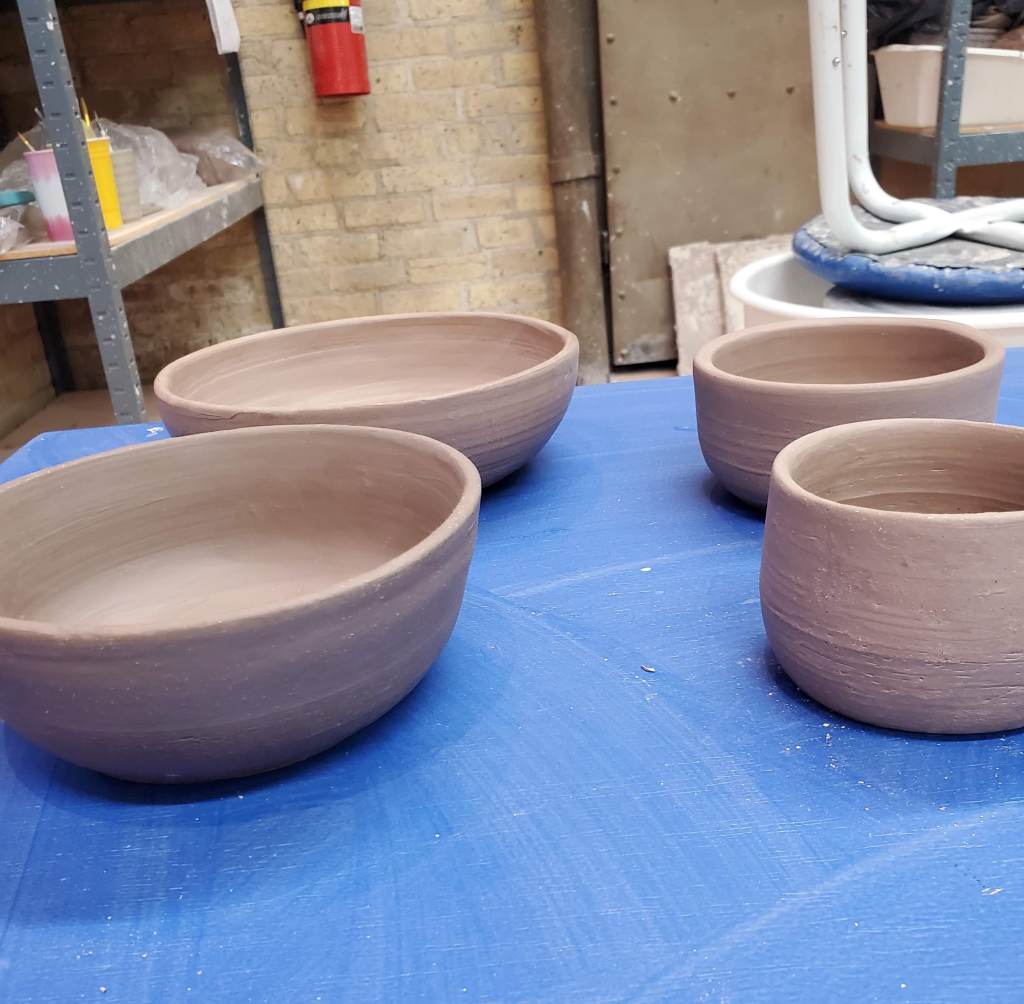
Two large clay bowls and two small clay bowls sit on a worktable in a pottery studio. They are ready to dry out and then be fired in a kiln.
Four of my pieces trimmed and ready to dry more before bisque firing. Photo by Natalie Roth

And for both, I find myself thinking: what comes next? For pottery, I quizzed the instructor on each of the upcoming stages. And for the self-published writing, I referred to Jane Friedman’s checklist: https://janefriedman.com/self-publishing-checklist/. In her checklist, she breaks down each stage in the self-publishing process so writers can plan how to move forward as they work through the editing, design, and proofing stages of a book.

Whether the project is clay-based or word-based, it is helpful to set it aside for a bit and return later with a fresh perspective. If you’re considering a copyedit for that part of the process, you can read more about the different types of “trimming” that I do by visiting my Services page.

Because Seven Ate Nine

This week it has been a joy to walk around and notice the leaves changing colors. Today I stopped to admire the trees lining my street, how orange and yellow leaves on some trees blend with the remaining green to create a mosaic of color in the bright blue sky. The crisp autumn air feels just right paired with those leaves.

Trees a mix of green, orange, and yellow leaves meet in a canopy above a residential street.
Admiring the autumn colors. Photo by Natalie Roth

It may be the lead-up to spooky season, of ghouls and monsters ready to pounce on trick-or-treaters, but it is also a season of apple pie and cozy sweaters, of trading in the sprinting pace of summer for the cozy comforts of fall.

One of my comforts this week is also the punchline to a corny joke (Why are all the numbers scared of 7?). That’s because section 7.89 is my go-to resource from the Chicago style manual when I’m checking whether to hyphenate a compound term. For instance, if a color is described in two words, do those words need to be hyphenated? It may depend on where the term is used in the sentence. I can wear an emerald-green sweater, but I’d say that the sweater is emerald green. “Emerald green” is hyphenated when it comes right before a noun, but it is left as two separate words when it is after a verb. This applies to a lot of compound terms. George Washington is on the one-dollar bill (hyphen), and this bill is worth one dollar (no hyphen).

Something else to consider with hyphen use is what the part of speech is. A compound noun may be two words, but then it needs a connecting hyphen when it is used as an adjective. If a class lasts a half hour, I can describe it as a half-hour class. If I like mountain climbing, I’d be considered a mountain-climbing enthusiast. That hyphen makes it clearer that the noun is being used as an adjective—that the reader should keep reading for the noun.

Those are my two favorite hyphen uses to remember. For everything else, I turn to 7.89 and look up the compound term and whether hyphens are recommended. It’s reassuring to see clearly written on the page that it is correct to say a ten-year-old (hyphenated noun) as well as a ten-year-old child (hyphenated adjective), but to omit the hyphens if I wanted to say a child is ten years old…and yet, all three individuals are likely to be eagerly awaiting their candy haul at the end of the month!

Whether your writing leans into the spooky or cozy sides of the season, consider how the thoughtful attention of an editor can improve the consistency and clarity of your project. Learn more about the stages of editing on my Services page.