Each Other versus One Another

“Love each other dearly always. There is scarcely anything else in the world but that: to love one another.”
― Victor Hugo (Les Misérables, Part V, 1887)

What comes to mind when you hear this quote? Is it perhaps an echo of Valentine’s Day? Or a reminder of the need for kindness?

As an editor, the other thing that jumps out to me is the interchangeable use of “each other” and “one another.” This use matches how many people write and talk, but not everyone would agree. Some grammarians recommend using “each other” if referring to two people, and then using “one another” for three or more people. So, a one-on-one chat lets you catch up “with each other” but a group meeting (3+ people) may be to compare notes “with one another.”

Applying this logic to the Hugo quote would shape the meaning of the entreaty to love each other to apply to a couple, while the maxim to love one another would have a more universal quality.

a close-up of smoothed over beach rocks
Two, three, four… I lost count! Beach pebbles stacked on one another. Photo by Natalie Roth

And yet, as confirmed in Merriam-Webster, in actual usage this distinction is often not observed and hasn’t been since the 16th century. The terms can very easily be interchanged. Many people prefer to always use “each other” as it can sound less stuffy, while others switch between the two terms with ease.

In my different editing capacities, I’ve come across style guides that make the distinction, and others that do not. Again, both terms are correct if your style guide allows. Even the dictionary approves of a choose-your-own-adventure approach to these terms. There is one choice I would always flag, however, and that is one I came across in a published book this week: “each another.”

Do you prefer “each other” or “one another”? Would you interchange them, or perhaps even blend them into the term “each another”? Let me know by sending me a note on my Contact page.

Rethink These Phrases in Fiction Writing

“I think to myself, therefore I am.” —René Descartes, not the actual quote.

An animated pencil is looking out the window and has a thought bubble with a question mark inside.

This week I’ve been reading Dreyer’s English, which is densely filled with editing tips on grammar, clarity, and style. From among the many tips in his section for fiction writers (and copy editors), I was taken by his caution against overexplaining everyday gestures. For example, I nod my head—not other body parts. So why not simplify and say: I nodded. I shrug my shoulders—and there aren’t any other body parts you think of if you hear that I shrugged. And finally, I think to myself—I can’t think to anyone else. Dreyer suggests cutting it down to “I think.” These simple edits in a text would look like this:

·        He nodded his head in agreement. > He nodded.

·        She shrugged her shoulders. > She shrugged.

·        I think to myself, Where did the time go? > I think, Where did the time go?

·        I think to myself, What a wonderful world. > I think, What a wonderful world. (Okay, here you may see the difference between lyrics and prose writing. This worked better the first way when Louis Armstrong sang it.)

These tips may not be a fit for every writer and every style of writing, but they are nonetheless approachable, simple tweaks that unclutter a piece of writing. A copy editor’s role is to notice these types of redundant phrases that the writer may have missed and, by doing so, give them the opportunity to think more consciously about their writing.

And what about those times when your character can think at someone else, rather than to themselves? I copyedited a YA novel about mind reading and high school, and the characters did just that. Read the full plot of Mysterious Ways here. This book is also featured on my Projects page.

Pencil image created using Bing AI’s DALL-E 3, January 17, 2024.

Improve Your Writing with “Less is More”

It’s the time of year in Chicago when coughs and sniffles are a steady background track to our daily activities. Part of that is unenviable throat clearing. It could be pre-cough, post-cough, or a simple reaction to the dry air. But throat clearing is usually not a sign of strong health, nor is it a sign of strong writing. 

Throat clearing in writing refers to words or phrases that are unnecessary to the author’s message. Eliminating these words from your writing can lead to more effective, focused prose. For example: “I’m really pretty happy with the direction this whole project seems to be going in” is a long way of saying “I’m happy with the progress of the project.”

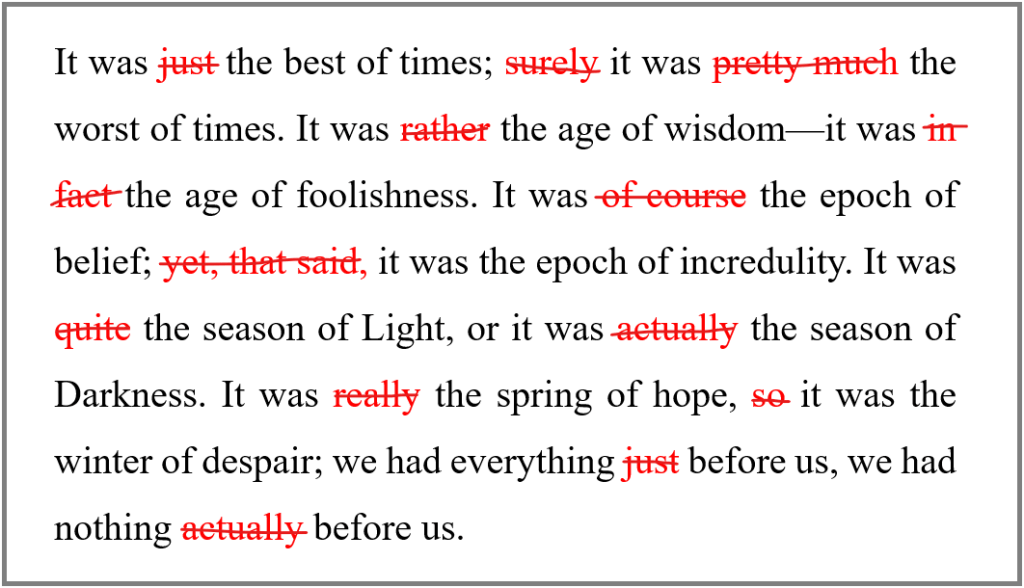
Imagine if Charles Dickens had been throat clearing at the start of A Tale of Two Cities. Would it be as memorable today?

In Dreyer’s English, longtime copy chief of Random House Benjamin Dreyer suggests an exercise for both writers and editors: to spend one week without using “throat clearers” in writing or speech. If you take out these little words and find there isn’t much substance remaining, it may be time to rework the sentence.

The following terms are considered throat clearers and can often be eliminated to strengthen writing:

  • very
  • rather
  • really
  • quite
  • that said
  • actually
  • in fact
  • just (to mean merely)
  • so
  • pretty (as an adverb: it’s pretty cold, we were pretty happy with it)
  • of course
  • surely

That said, I’m actually quite sure that this task would surely be a challenge for many. Or, without the throat clearing: This may be a difficult task. But it can also be helpful in thinking through what you want to say and using more precise words to get there.

Looking to pare down your text with expert help? Consider what option may work for you by reviewing my Services page.

*Read the full text of A Tale of Two Cities for free on Project Gutenberg.

To Be or Not to Be Capitalized in a Title

Now that we’ve reached October, Halloween decorations have been slowly popping up in my neighborhood. Each time I go for a walk I see new cobwebs, gravestones, pumpkins…and lots of skeletons. Skeletons that are five inches to twelve feet tall, that have two heads, or light up, or are dressed up for the colder weather. Some are just a head and bony hands reaching out from the grass or supported by a tall shrub, reminding me of Hamlet holding a skull in the iconic scene from Shakespeare.

A skeleton wearing a floppy black felt hat has its hand out as if giving a friendly hello
A friendly neighborhood skeleton greets passersby. Photo by Natalie Roth

When I get back from my walk around the block, I sit down to edit the subheadings of a science article and I find myself recalling another moment from Hamlet—that phrase, to be or not to be—as I review which words to capitalize.

It’s those little words that get me. To, it, as, but, for. When you’re writing a title, heading, or subheading, there’s no one right answer for capitalizing these little words. For instance, I’ve titled this post in Chicago style: conjunctions like “or” stay lowercase and so do articles (i.e., a, an, the). The preposition “to,” meanwhile, is capitalized when it’s the first word but not when it’s in the middle of the title. Now if I were to write the title in AP style, which is typically used for newspapers and magazines, the “to” gets capitalized both times, because AP style also capitalizes the word when it is used as an infinitive (the infinitive here being “to be”).

So the answer to which words get capitalized in a heading depends on the context of how the word is being used and the style of the document—a newspaper headline won’t follow the same guidelines as the subheading of a nonfiction trade book, for instance.

When in doubt, or if you’re curious to compare all the style guides, you can check out https://capitalizemytitle.com/. This free tool lets you type in any headline and toggle among Chicago, AP, MLA, APA, and other styles to see what words to capitalize. Like any digital tool, it might not always pick up on things that a human would, such as whether a word is being used as an adverb (the other instance of capitalizing “to”), but it is a great start to proper formatting and a quick way to double-check your thinking as you review the capitalization in titles and headings.

Whether you’re dusting off the cobwebs of an old piece of writing or drafting fresh content from a bare-bones outline, consistent capitalization is a small way to add a little extra boost. Do you have a piece of writing ready for those decorative touches? Tell me about it using my Contact page.

Steel and Music

Since my last post on editing out the fluff, I happened upon the book Stylized by Mark Garvey, which dives into the history behind Strunk & White’s The Elements of Style. Garvey follows the publication journey of the book as E. B. White worked to update Strunk’s original rules, with side journeys into the style guide’s meaning and impact. This iconic style guide aligns with the idea of removing fluff, with one rule simply stating “omit needless words.” Yet, as Garvey explains, this isn’t an all-encompassing or straightforward right-and-wrong guide to writing. Strunk had simply noticed what good writers were doing and used his style guide to point out the rules beneath their words.

E. B. White was one of the students influenced by this approach to writing, and his appreciation for Strunk’s teaching led to his involvement in getting the style guide more widely published as we know it today. White spent many years writing at The New Yorker, and playwright Marc Connelly reportedly described his contribution as bringing “the steel and the music to the magazine.” Consistently applying rules of language gave him a strong base on top of which his writing could sing.

A picture of the Walt Disney Concert Hall in Los Angeles. It is known for its acoustic design within and its multiple panels of stainless steel on the outside, shaped like sails.
Steel and music come to life in the curved stainless steel of the Walt Disney Concert Hall, an iconic building designed by architect Frank Gehry to bring music to the city of Los Angeles. Photo by Natalie Roth

An analogy Garvey uses to explain this idea of steel and music, or rules and play, is to think of the way a bird relies on rules in nature. It needs gravity, friction, wind, and air pressure to get where it’s going. In the same way, a good writer learns the rules of language so that they can then navigate and play with them to get where they want to go.

As an editor, I work with an author to help them get where they want to go with their writing. Often that means applying grammar and style rules in a way that improves clarity and flow. When I took a class in grammar for editing, the somewhat dry material certainly didn’t feel like play—because it was the steel. I can now use this steel to reinforce and empower the creativity of the author, and it is then that we get the music.

Do you have a piece of writing you want to sing? Tell me about it using my Contact page.